

A service manager at an equipment dealer gets a call on a Monday morning. A competitor’s machine has broken down, and the customer needs a replacement part this week. Somewhere in the manufacturer’s catalog sits a part with matching specs that would fit. Nobody at the dealer can see that. The order goes to the competitor.
Multiply that moment across thousands of SKUs and every competitor machine already in the field. The customer wants the part. The manufacturer makes it. Nobody has a competitor parts cross reference that links the two.
Why a Part Number Does Not Tell What a Part Fits
Two parts from different manufacturers can carry completely different part numbers and still be interchangeable.
A match comes down to engineering: specs, materials, dimensions and tolerances. If one of them is off, the part does not fit, however close the listing looks. Interchangeability can also run one way, where part A can replace part B but part B cannot replace part A. That is why a simple part number lookup never gives the full picture.
The Aftermarket Revenue Behind a Competitor Parts Cross Reference
Every competitor machine in the field will need parts, and some of those parts may already sit in the manufacturer’s catalog. Selling them needs no new product. The engineering is done. The parts are already being made. Until someone maps which ones fit, that aftermarket revenue keeps going to the competitor. For one Fortune 500 manufacturer, the gap was worth millions a year.
The overlap runs the other way too. Competitor parts that fit the manufacturer’s machines can pull service revenue out of its own installed base. A full map shows those parts too, so the business knows where it is exposed.
Why Manual Cross Referencing Keeps Getting Shelved
Most manufacturers know the opportunity exists. It gets discussed every year and shelved every year, because the data is scattered across PDFs, web pages, scanned data sheets and inconsistent catalog listings. Each source describes the same attribute differently, and a competitor landscape can run to hundreds of sources and hundreds of thousands of SKUs.
Matching has to happen attribute by attribute across every source. At that scale, no team can staff it by hand.
What a Competitor Parts Cross Reference Has to Get Right
A cross reference is only worth selling from if the sales team can trust it. Before backing one, an aftermarket leader should be able to answer four questions.
- Does it cover the messy sources? Most competitor data sits in scanned data sheets, PDFs and web listings. A cross reference built only from clean spreadsheets misses much of the competitor range.
- Does it read units the same way? “25 mm” in one catalog and “0.98 in” in another describe the same bore. If the comparison misses that, real matches slip through.
- Does it record which way a part fits? A part can replace a competitor’s part without the reverse being true. The map has to show direction.
- Who signs off before a part is quoted? A wrong match means returns, warranty claims and damage to the brand. Borderline matches need an engineer’s approval.
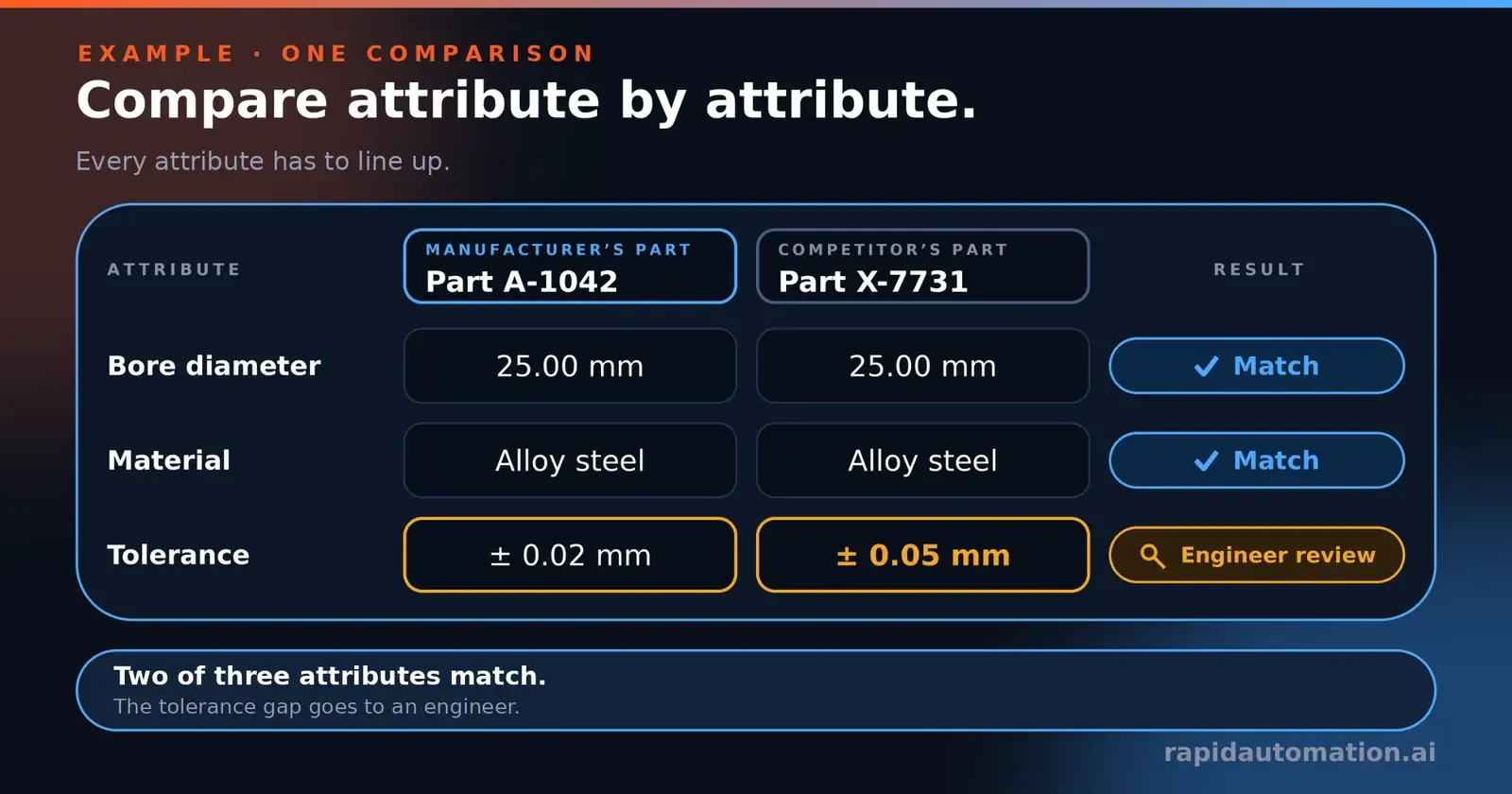
Two parts compared on bore diameter, material and tolerance. Bore diameter and material match, and the tolerance difference is flagged for engineer review.
What 60,000 Matches Looked Like for One Manufacturer
A Fortune 500 equipment manufacturer had this problem. Its leaders knew that many of their parts could fit competitor equipment already in the field. What they lacked was a map. “We tried RPA. We tried big consultancies with data platforms. Nothing handled the variation,” its VP of Aftermarket said.
RAPFlow read every source and matched on engineering attributes. Uncertain matches went to an engineer.
The outcome was a validated database of 60,000 parts that the commercial team could sell as direct replacements into competitor equipment, using products the company already manufactured. It surfaced millions in annually recurring revenue and keeps finding new matches as competitor catalogs change.
Read how one manufacturer cross-referenced 60,000 competitor parts. To see what a cross reference could turn up in a specific catalog, book a conversation with the Rapid Automation team.
Where RAPFlow Fits
RAPFlow builds a competitor parts cross reference and keeps it current as competitor catalogs change. It works alongside the systems a manufacturer already runs, without replacing them. Borderline matches go to an engineer through RAPFlow VerifyMe, the platform’s review queue. The commercial team gets a validated list of parts it can sell into competitor equipment, updated as new matches appear. It all runs inside the manufacturer’s own infrastructure. No catalog or engineering data leaves the building.
Questions Leaders Ask About Parts Cross Referencing
Can two parts with different part numbers be interchangeable?
Yes, when their specs, materials, dimensions and tolerances line up. Fit can also run one way only, so each pairing is checked in both directions.
How can a competitor parts cross reference cover thousands of SKUs?
By automating attribute extraction and matching across every source. One Fortune 500 manufacturer cross-referenced 60,000 competitor SKUs this way, and the matching keeps running as catalogs change.
Can AI automate parts cross referencing?
Yes, if it can read scanned data sheets, PDFs and web listings as well as clean spreadsheets. RAPFlow handles all of these.
How Much of a Competitor’s Installed Base Could a Manufacturer’s Parts Serve?
That service manager will take another call next week. Find out how many of those orders a cross reference could win back.
Take the next step
Ready to Move From Exploration to Execution?
Leading manufacturers are closing the AI execution gap right now. Book a demo and see your operation transformed in 90 days.